

Engineering
Request a Job Quote
Submit a Quote Form and a Southway Sales Representative will be in contact with you as soon as possible.
GET A QUOTELift Planning & Engineering
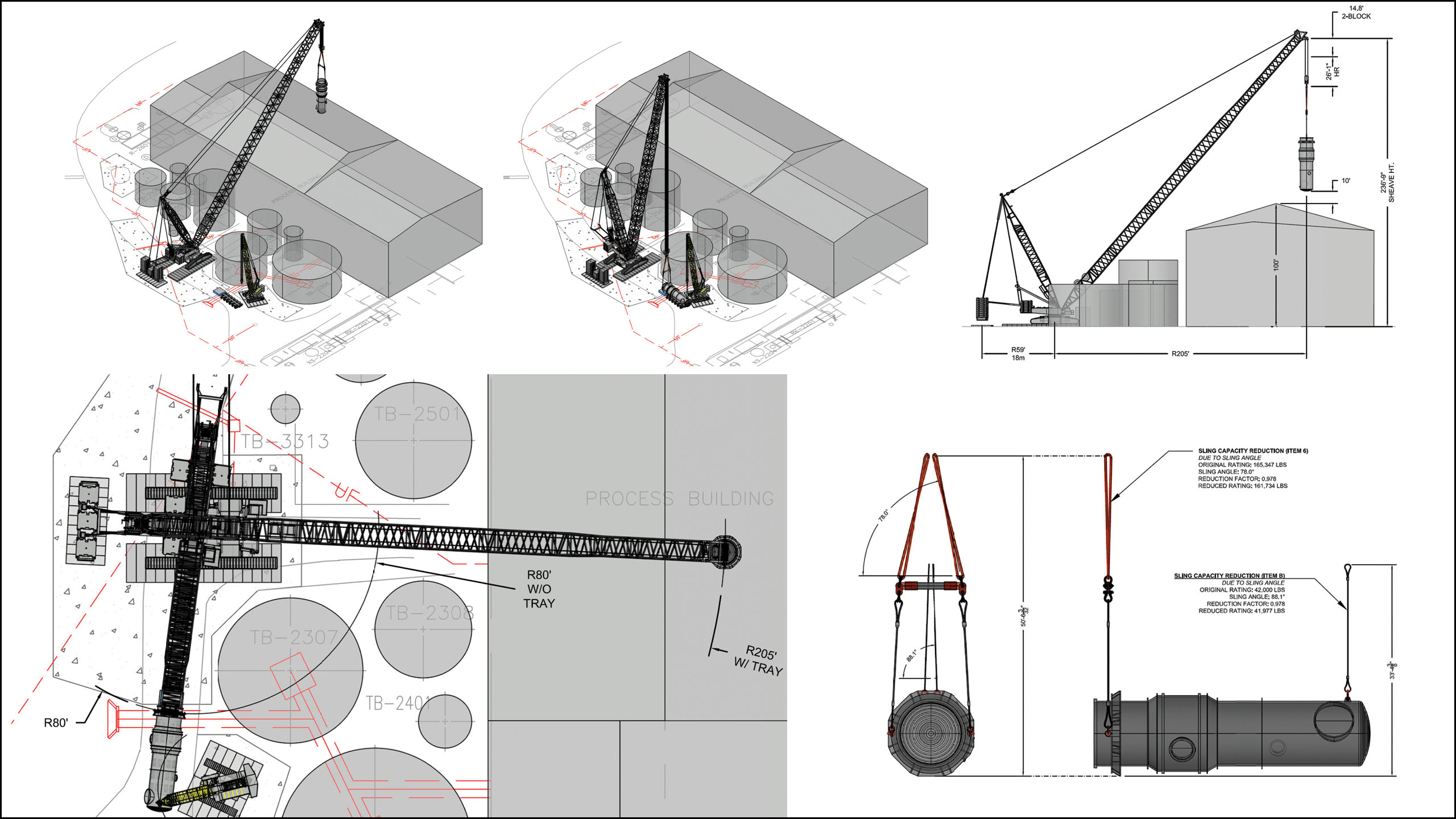
Plan the Work – Work the Plan
Precision & Accuracy
These plans are built with precision and accuracy with a mission to ensure the customer and our field personnel that we have planned for the safest and most efficient options available. We also offer the option for P.E. review and stamp of approval upon request.
Planning Process
- + Project Overview with Customers & Contractors
- + Detailed Rigging Diagrams & Critical Lift Plans
- + P.E. Review & Stamp Available Upon Request
- + Site Walks & Measurement Verifications
- + Maximum Allowable Wind Speed Study
- + Ground Bearing Pressure Study
Frequently Asked Questions
When is a critical lift plan required?
A critical lift plan is required when a lift exceeds 75 percent of the crane’s rated capacity, involves multiple cranes, requires hoisting personnel, places loads outside the operator’s view, or uses non-routine rigging configurations. Southway Crane & Rigging provides comprehensive critical lift planning with professional engineer review and stamp available upon request.
How far in advance should lift plans be submitted?
Standard lift plans should be submitted at least 48 hours prior to crane mobilization, while critical lift plans require five business days advance notice. This timeline allows for thorough review, professional engineer evaluation when needed, and coordination with all stakeholders before crews arrive on site.
What is ground bearing pressure analysis?
Ground bearing pressure analysis calculates the force exerted by crane outriggers or tracks onto the supporting surface to ensure the soil can safely support the equipment and load without failure. We evaluate soil bearing capacity, determine required crane mat sizes, and verify that ground conditions can withstand concentrated loads that can exceed 10,000 pounds per square foot for larger cranes.
How is maximum allowable wind speed determined?
Maximum allowable wind speed is determined by crane manufacturer specifications, load characteristics, boom configuration, and site conditions evaluated by a competent person. Southway Crane & Riggin provides site-specific wind speed studies that consider equipment limits, load surface area, and real-time weather monitoring requirements to establish safe operational parameters.
What information do I need to provide for a lift plan?
You need to provide accurate load weight with supporting documentation, load dimensions and center of gravity, pick and set locations, site conditions including soil type and utilities, required lift radius and height, and rigging attachment points. Information about overhead hazards, access routes, and project schedule also helps us develop comprehensive plans tailored to your operation.
How long does it take to complete a lift plan?
Standard lift plans typically require two to three business days once all project information is received, while critical lift plans may take five to seven business days depending on complexity. Providing complete information upfront helps expedite the process while ensuring thorough safety analysis and coordination.
What is included in a site walk verification?
Site walk verification includes physical inspection of crane setup locations, measurement verification of clearances and obstructions, validation of access routes, identification of overhead hazards and underground utilities, and confirmation of adequate space for operations. We document actual site conditions and identify any discrepancies from design documents before mobilization.
What is the difference between standard and critical lifts?
Standard lifts operate below 75 percent of crane capacity, use routine rigging, and maintain loads within the operator’s view. Critical lifts exceed 75 percent capacity, require multiple cranes, involve complex rigging, or present significant consequences if issues occur, requiring detailed written procedures, additional safety precautions, and often professional engineer review.