

Understanding the Load Capacity of Rough Terrain Cranes
- April 14, 2026
At Southway Crane & Rigging, understanding the load capacity of rough terrain cranes is foundational to every lift plan our engineering team produces. With more than 34 years of specialized lifting experience and a fleet of 200+ cranes, we’ve seen what happens when project teams treat rated capacity as a fixed number rather than a variable one. The capacity of a rough terrain crane shifts with every change in boom length, load radius, and site configuration, and selecting equipment without accounting for those variables creates both safety failures and project delays.
Learn all about the differences between rough terrain cranes and crawler cranes.
Rated Capacity is Not a Single Number
A crane rated at 80 tons cannot lift 80 tons in most working configurations. Rated capacity reflects the maximum load allowable at a specific radius and boom configuration, calculated as a percentage of the crane’s tipping load. Extend the boom, increase the load radius, or add a jib attachment, and that number drops, sometimes sharply.
Four variables control what a rough terrain crane can actually lift on your job site:
- Load radius: The horizontal distance from the crane’s center of rotation to the load. Increasing radius reduces capacity significantly.
- Boom length and angle: Longer boom extensions shift the physics against the crane. Capacity decreases as boom length increases.
- Boom configuration: Main boom only versus main boom plus jib are rated separately and must be read from distinct sections of the load chart.
- Ground bearing pressure: Outrigger pad placement and substrate conditions affect how rated capacity translates to real-world lifting limits.
These variables interact. Extending the boom increases the effective radius, which means a single configuration change affects multiple capacity values simultaneously.
How to Use a Load Chart
Load charts are manufacturer-produced documents that define safe lifting capacity at every combination of boom length and load radius. Reading one correctly requires knowing your lift radius before you arrive at the chart, not after.
Confirm whether outriggers are fully extended, partially extended, or if the crane is lifting on rubber, as each condition has its own rated capacity column. From there, identify the boom length that matches your lift configuration and cross-reference with your required load radius. Every rigging component, including slings, shackles, blocks, and hooks, must be included in the total load calculation.
ASME B30.5 and OSHA 29 CFR 1926.1416 both require that crane operations remain within manufacturer-specified rated capacities.
Rough Terrain Capabilities and Constraints
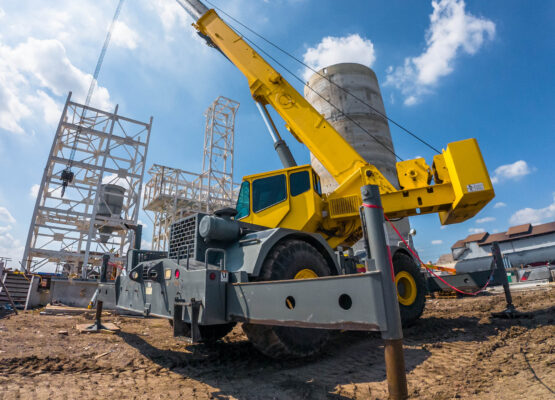
Rough terrain cranes are built for unimproved job sites. Four-wheel drive, large-format tires, and compact dimensions make them deployable where truck cranes cannot operate. Setup is fast, and many lifts can be executed with partial outrigger extension.
Rough terrain cranes are not street-legal and require transport to every job site. On soft or unstable ground, tracked equipment offers greater stability. For lifts that exceed the capacity range these cranes are designed for, all-terrain or crawler cranes demand consideration.
Match Equipment to the Lift Before the Crane Arrives
Selecting the right rough terrain crane requires verified load data, accurate radius measurements, and site condition assessment before any equipment is dispatched. Our engineering team produces critical lift plans and rigging diagrams for complex jobs, work that protects your timeline and your crew. Submit your project details through the contact form on our website and we will get back to you as soon as possible.
Related Blogs
- February 24, 2026
Rough-Terrain Cranes vs Crawler Cranes
Choosing Between Rough-Terrain Cranes and Crawler Cranes Choosing the right type of crane can make a.